

On Saturday, airlines across the U.S. cancelled thousands of flights as they attempted to recover from a nationwide ground stop that occurred the day before, leaving many passengers in a frantic search for available seats and causing travel disruptions worldwide.
According to Bryan Bedford, the administrator of the Federal Aviation Administration (FAA), the air travel schedule in the U.S. is expected to return to normal by the end of Sunday, just two days after what marked the country’s longest ground stop in 25 years. Bedford addressed reporters in Washington, D.C., on Saturday.
He noted that while airlines would still experience delays and cancellations on Saturday, he reassured that “the worst is behind us.”
U.S. Transportation Secretary Sean Duffy explained that the issue arose when the contractor L3Harris Technologies Inc. was in the process of replacing a segment of the outdated copper wiring in the air traffic control system with new fibre optic wiring, which inadvertently caused the system to overload.
This work resulted in “intermittent” communication failures and radar gaps, leading the FAA to implement a ground stop for over four hours.
Duffy mentioned that officials are looking into whether the contractor’s “incompetence” or a malfunctioning router was to blame.
L3Harris has stated it is cooperating with the FAA’s investigation to “understand the circumstances” that resulted in the ground stop.
In a statement, L3Harris emphasized, “We take the nationwide ground stop and its implications for travelers, airlines, and air traffic operations very seriously.”
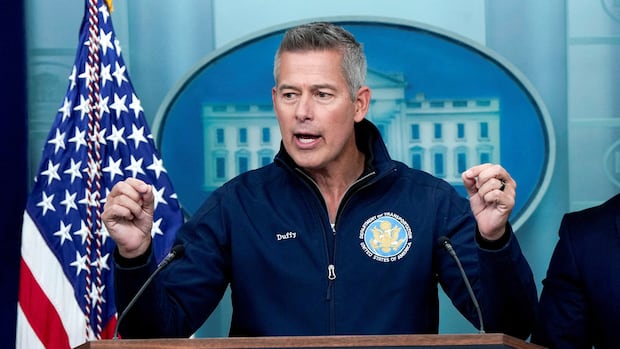
U.S. Transportation Secretary Sean Duffy attributed the now-cancelled national ground stop that complicated air traffic to ‘outdated equipment’ and insufficient Congressional funding, occasionally sounding like a partisan critique of Democrats.
This nationwide ground stop was the first since January 2023, when a critical FAA computer system that alerts pilots experienced a malfunction, and the second since the September 11, 2001, terrorist attacks.
Aviation consultant Andrew Charlton noted that the disruption on Friday impacted about 25% of the 45,000 flights that operate daily in the U.S.
-
B.C. travelers face significant costs due to cancellations linked to U.S. ground stop
-
Operations at Montreal’s Trudeau airport gradually returning to normal post U.S. ground stop
“The ripple effect is immense. Aircraft do not simply fly from one location to another and then halt. They continue on to subsequent locations,” he explained.
“This situation is particularly aggravated when considering long-haul international flights over the Atlantic or Pacific Oceans.”
‘I just want to go home’
At various airports in the U.S. on Saturday, travelers were still attempting to navigate their way to their intended destinations. Some opted to wait out the turmoil in hotels, while others rushed to secure rental vehicles or bus and train tickets. Many found themselves spending the night in airports.
Dan Russell, 66, discovered that his connecting flight to Fresno, California, had been cancelled just thirty minutes before the scheduled boarding in San Diego on Friday evening. With hotels fully booked, he and his wife, returning from Hawaii, decided to wait at the airport for a rebooked flight.
“There’s nothing you can do,” Russell remarked, as his wife Mary attempted to rest on his shoulder.

CBC’s Steve Futterman interviews a traveler at Los Angeles International Airport who was dealing with only about an hour and a half of sleep while trying to resolve flight issues following the U.S.-wide ground stop on November 13.
At Newark Liberty International Airport in New Jersey, Umi Egchi was seeking to determine when his flights would align so he could return home to Japan.
“I’m not exactly sure what happened. I just want to go home,” Egchi stated, wearing a sleep mask on his forehead.
FlightAware, a flight tracking website, reported that over 5,100 flights within, entering, or exiting the U.S. were cancelled on Saturday.
Officials assure public that safety is intact
Duffy reiterated on Saturday that no passengers were in danger, as more than 3,000 flights already in the air at the time of the grounding order landed safely.
Officials from the Trump administration also pointed fingers at Congress for not approving additional funding necessary to replace the aging technology that is crucial for managing air traffic in the country. Duffy indicated that while 70% of the system has been upgraded with fibre optic wiring, the agency still requires new air traffic control towers and runways.
The FAA has transitioned thousands of old copper wires to fibre optic lines and has modernized hundreds of radio systems as part of a comprehensive overhaul initiated last year after Congress allocated $12.5 billion in funding. Duffy and the White House are advocating for an additional $30 billion to finalize the upgrades.
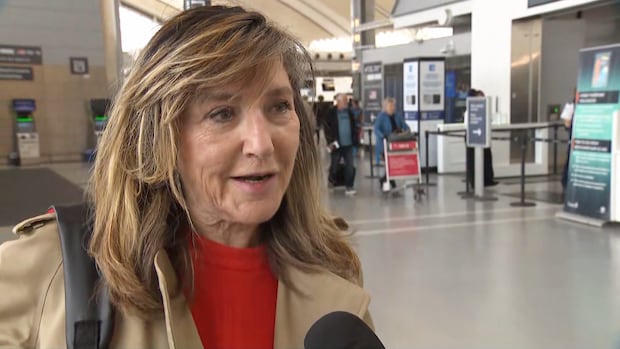
CBC’s Jennifer Yoon speaks to a Canadian passenger who was among the many affected by the U.S. ground stop at Toronto Pearson Airport.
Duffy emphasized, “We have outdated infrastructure throughout the airspace,” while affirming that flying remains safe. “You won’t reach your destination if we do not believe you can get there safely.”
He mentioned having had multiple conversations with U.S. President Donald Trump since the ground stop was enacted, yet the president has remained silent on the issue. He has not made any public statements or posted on social media regarding the matter, although he did have a phone conversation with a Fox News reporter, which was not recorded on camera.
Charlton highlighted the challenges of upgrading a system that cannot afford to go offline.
“What you are witnessing is akin to attempting to change the tires on your car while driving at 80 mph down the freeway, as nothing in aviation can be halted,” remarked the aviation consultant.
Historical Context
The issue on Friday resembled a regional air traffic control communication outage that occurred in September, which caused significant delays for numerous flights across the U.S. Northeast. That incident was attributed to a construction crew accidentally severing a fibre optic line.
Previous radar outages last year that affected Newark airport were also blamed on aging equipment.
Aviation safety expert Steve Arroyo noted that the scale of the disruption on Friday was particularly significant, as it left controllers unable to communicate effectively with pilots.
“Without that communication ability… you have no choice but to ground airplanes to avoid the risk of losing contact with them,” stated Arroyo, a former United Airlines pilot.