

Officials have characterized the situation as “complete disorder,” “unsustainable,” and “a breach of regulations.”
Over 50 people have lost their lives following the breach of the Moroccan border into Spain’s Ceuta enclave by tens of thousands of migrants, causing astonishment and discord in Europe.
An estimated 60,000 individuals entered the Spanish enclave in North Africa on Thursday, with around 48,300 returning to Morocco by Friday evening.
Some migrants swam approximately five kilometers from the Moroccan town of Fnideq to reach Ceuta, while others attempted a shorter crossing from the nearby town of Belyounech.
Describing the challenging journey, one swimmer in a wetsuit informed France 24 that it took them two hours to complete. Another swimmer mentioned how tough the experience was.
Notably, there were children and unaccompanied minors among those who crossed, prompting concerns from a Moroccan NGO about the risks involved in taking children on irregular migration paths.
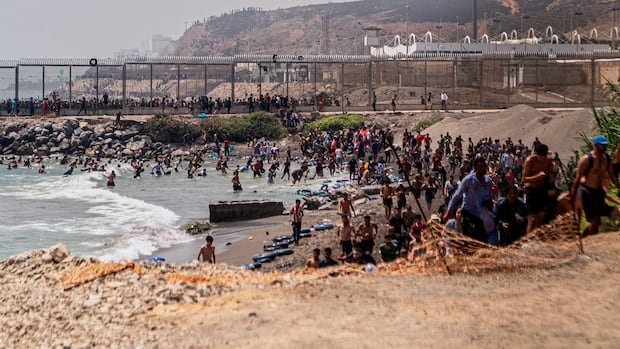
Spain sent troops to bolster police presence after numerous migrants crossed into Ceuta from Morocco, resembling a similar event in 2021 when thousands entered the territory.
Spanish authorities reported the recovery of 57 bodies on the Spanish side of the border, with the possibility of additional casualties on the Moroccan side. The fatalities included individuals who drowned or were crushed while attempting to climb the border fence.
A Moroccan, identified only as Abdelhakim by Agence France-Presse, recounted walking 14 kilometers to reach the Morocco-Spain border and witnessing tragic deaths during a sea crossing attempt.
Here is a summary of the events that unfolded and the reasons behind them.
What is Ceuta?
Ceuta and Melilla, Spanish territories located on the northern Mediterranean coast of Africa, serve as the European Union’s sole land borders with Africa. Both cities have faced periodic surges of migrants attempting to enter Europe, with the recent influx being unprecedented.
Ceuta, an 18.5-square-kilometer peninsula with a population of approximately 83,000 people, witnessed a surge in population by 73% when 60,000 individuals reached the border in a single day. Separated from mainland Spain by the Strait of Gibraltar, Ceuta has a diverse population of Christians, Muslims, Spaniards, and Moroccans.
Although Morocco does not formally acknowledge Ceuta and Melilla as Spanish territories, referring to them as occupied lands, these territories remain crucial migrant destinations.
Why is it a migrant destination?
Spain serves as a key entry point into Europe for migrants seeking improved economic prospects or refuge from violence in their home countries. Ceuta and Melilla, heavily fortified territories, attract migrants aiming to reach Spain from Morocco and other African regions. Typically, many migrants are either turned back upon arrival or processed in migrant centers, where they can apply for asylum.
As noted by NPR in 2014, migrants arrive at Ceuta seeking European healthcare and employment opportunities. Many of those who attempted the crossing on Thursday expressed hopes of finding work upon reaching Ceuta.</p