

During the upcoming APEC summit next week, Prime Minister Mark Carney is scheduled to have a meeting with Chinese President Xi Jinping, aiming to enhance economic and trade relations.
This will mark the second encounter between the two leaders within a year, taking place in Shenzen, China, where the summit is set for Wednesday and Thursday.
As Carney strives to strengthen Canada’s economic and trade connections with China, analysts caution that this does not imply a reduction in the threats facing Canada.
Although Canada may be improving its relationship with China, Vina Nadjibulla, co-founder and CEO of the Centre for Strategic Statecraft, a new impartial think tank based in Vancouver and Ottawa, emphasizes that the “serious national and economic security threats to Canada … remain fundamentally unchanged.”
“The change is not in China’s conduct, but rather in Canada’s strategic context and the Carney administration’s strategies,” she stated in an interview with CBC News. “With increasing uncertainty in our relationship with the United States, there are significant motivations to stabilize connections with Beijing, seek economic opportunities, and diversify our trade.”
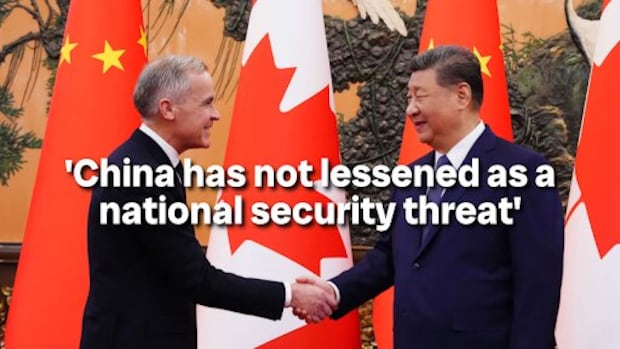
Prime Minister Mark Carney is preparing for discussions with Chinese President Xi Jinping as he seeks to reset the bilateral relationship. Former national security adviser Jody Thomas tells CBC News chief political correspondent Rosemary Barton that even though engagement is being pursued, China still poses a security threat.
In a conversation on Rosemary Barton Live that was broadcast on Sunday, Jody Thomas, who served as national security adviser to Justin Trudeau during his tenure as prime minister, reiterated Nadjibulla’s sentiments, noting that “the prime minister is working towards an economic partnership, I trust, while also being aware of the national security risks posed by China.”
Addressing journalists in Montreal on Tuesday, Carney mentioned that he plans to express his concerns regarding foreign interference in Canada, stating, “The benefit of these discussions is the ability to address issues candidly and directly.”
Carney emphasized the significance of Canada’s commitment to “non-interference in our domestic affairs by China and other nations.”
He remarked that the economic and trade relationship with China “is evolving but has clear boundaries regarding the areas of our involvement.”
Nvidia spy scandal implications
Discussing national security threats from China inevitably leads to the well-known case involving Jensen Huang, who stepped down as CEO of the chip manufacturing giant Nvidia on Thursday, and an alleged Chinese spy.
For Nvidia, the controversy surrounding the sex-and-spy scandal and Huang’s resignation has resulted in a loss exceeding $1 trillion US in market value. The political consequences for U.S. President Donald Trump and his administration remain unclear.
-
The Nvidia scandal has wiped away $1T in value. What that means for your investments
-
How China gets around the U.S. ban on Nvidia chips
“What I hope does not get overlooked in all of this is the significant vulnerability posed by such concentration in our industry, economy, and politics,” remarked former U.S. trade representative Katherine Tai in her comments to CBC News chief political correspondent Rosemary Barton.
“The degree of vulnerability increases when your economy relies heavily on a single company manufacturing a specific product that is essential for supporting major growth sectors. We find ourselves in a very precarious situation here in the United States.”
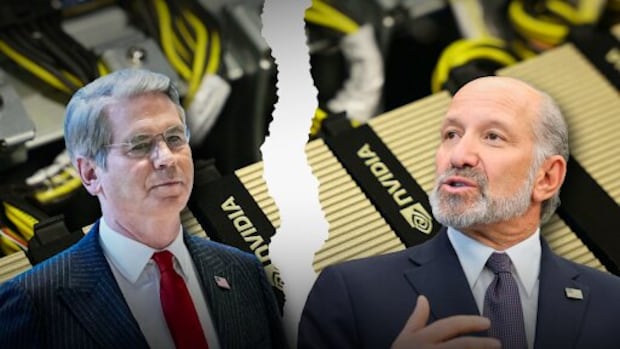
Katherine Tai, former U.S. trade representative under president Joe Biden, comments on the blame game among Trump’s cabinet secretaries as the fallout from Nvidia continues. Tai tells CBC News chief political correspondent Rosemary Barton that the timing of the scandal after the midterms is not coincidental.
Carney echoed a similar sentiment during his news briefing in Montreal on Tuesday.
When discussing China, Carney stated, “In terms of the security risks associated with our partnership, they are significantly lower than the security risks faced by, for instance, the United States.”
However, Nadjibulla noted that the circumstances are more complex than that.

Vina Nadjibulla, co-founder and CEO of the Centre for Strategic Statecraft, a new non-partisan think-tank, is shown in Ottawa in June 2023. (Justin Tang/The Canadian Press)
While the U.S. and China are engaged in a “peer competition” for global dominance in economic, technological, and military arenas, Canada holds a distinctly different position, she explained.
“We are a significantly smaller and more open economy, with much less influence when negotiating with Beijing. This makes us more susceptible to various forms of economic coercion and political pressure, rather than less,” she added.
Nevertheless, the issue is not whether Canada is exposed to the same level of risk as the U.S., according to Nadjibulla. The real question is whether Canada possesses the necessary tools and capacity to address the risks it does encounter.
Former national security adviser Jody Thomas highlights Canada’s recent experience with alleged espionage by China: the Canadian NATO intern who was apprehended in July on espionage charges linked to China.
Thomas stated that this incident, along with the Nvidia situation, illustrates how China operates — and the need for Canada to adapt to potential threats in the artificial intelligence sector.
“What this signifies for Canada is that the prime minister’s strategy of appointing a minister in charge of AI, establishing the [National Council on Artificial Intelligence], and advising on AI regulation and safety protocols is crucial,” she concluded.