

On Monday, Prime Minister Mark Carney arrived in China, where he is scheduled to meet with President Xi Jinping and various leaders from the Pacific Rim.
Carney is concluding a nine-day international trip with his fourth and final destination in Shenzhen, a technology center in southeastern China, to participate in the Asia-Pacific Economic Cooperation summit.
His initial official engagement will be a bilateral discussion with Xi on Tuesday morning. Prior to the trip, Carney expressed that Canada has the potential to enhance its collaboration with China particularly in agriculture, both clean and conventional energy, and financial services.
“We’ve set clear parameters on the key areas we intend to focus on… I’m utilizing our terminology, not theirs,” he stated to reporters in Phnom Penh, Cambodia, on Sunday, where he attended the Francophonie summit.
Earlier during this trip, he visited the Philippines for the Association of Southeast Asian Nations meeting, followed by a stop in Ireland for a European Political Community gathering.
Carney anticipates discussing “the development of the international system, China’s involvement in that, and Canadian priorities” with Xi.
A significant topic of conversation will be the investments from China in Canada’s automotive industry. Earlier this year, both nations consented to permit a limited number of Chinese electric vehicles into Canada.
Carney has expressed his desire for Chinese automotive manufacturers to establish operations in Canada, but only if they offer quality jobs, expressing concern about factories where workers assemble vehicles using parts primarily sourced from China.
He mentioned that trade negotiations with Washington will influence Canada’s stance on Chinese investment.
“This is integral to the trade negotiations,” he remarked. “Depending on the outcomes, there will be alternative options — European options, Asian options.”
“This is not leverage, but rather a response based on actions. It all depends,” he added.
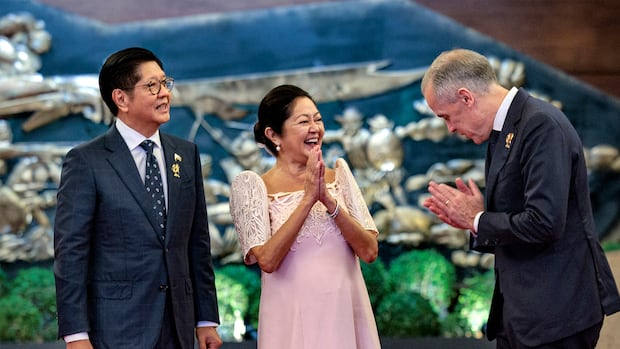
Prime Minister Mark Carney brokered two free trade agreements — set to be signed next year — that will significantly reduce high tariffs on Canadian exports to the Philippines and the 11-member ASEAN bloc, as part of an ongoing effort to diversify trade away from the U.S.
This marks the second occasion this year that Carney has met with Xi in China, as he visited Beijing in January for the first meeting between a Canadian prime minister and a Chinese president in eight years. The relationship between Canada and China had deteriorated during the administration of former prime minister Justin Trudeau, primarily due to allegations of foreign interference from China.
Before departing Canada, Carney indicated he would address foreign interference with Xi, leading a Chinese government spokesperson to refute any such claims.
Carney is also scheduled to engage with various leaders from the APEC forum, which consists of 21 economies on both sides of the Pacific that collaborate to reduce trade barriers. This group includes a diverse range of members, including Taiwan, Australia, and Peru.
According to Carney’s office, he will maintain his emphasis on attracting more investment and diversifying Canada’s trade.
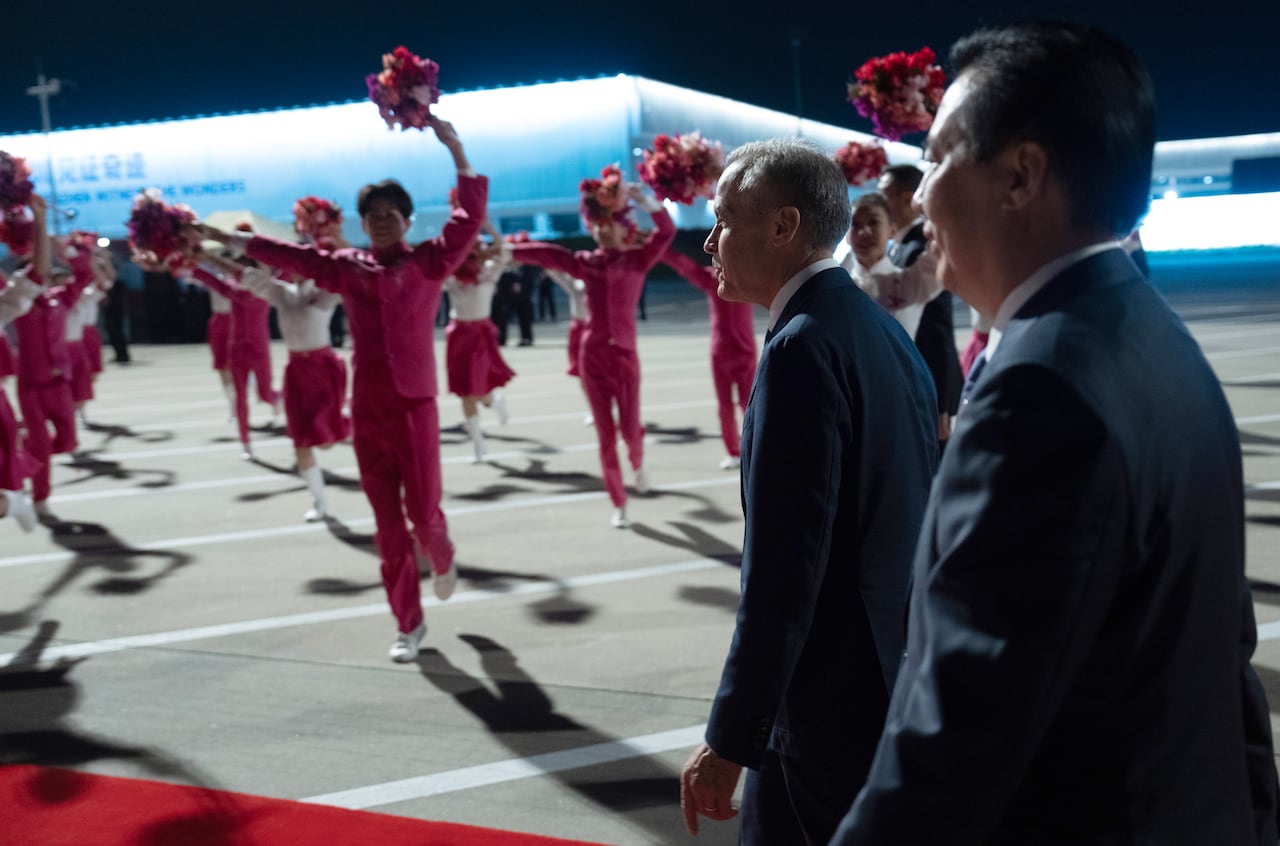
Dancers perform as Carney arrives in Shenzhen. (Adrian Wyld/The Canadian Press)
Vina Nadjibulla, co-founder of the Centre for Strategic Statecraft, expressed interest in observing whether Carney will permit increased Chinese investments in Canada “within critical sectors, including energy and technology, particularly concerning renewables and batteries,” alongside automotive manufacturing.
She remarked, “We must continually balance our relationship with China alongside our conversations with the U.S. — and monitor what transpires between the U.S. and China on a bilateral level.”
In 2022, Canada mandated three Chinese companies to divest their interests in critical minerals operations in Canada, citing concerns over national security.
Nadjibulla indicated that the summit should contribute to shaping the foreign policy review that Carney plans to present in the House of Commons in the coming weeks, as well as next year’s anticipated update of the 2022 Indo-Pacific strategy initiated by Trudeau.
“We now have a robust foundation,” Nadjibulla noted, highlighting that leaders from Asia have either visited Canada or have plans to do so, including Vietnam and India.
“Canada is finally being recognized and is relevant to their own diversification strategies and economic security and resilience agendas.”
She suggested that any update to Ottawa’s regional strategy should consider relations with Taiwan, a self-governing island claimed by China. The federal cabinet has left a trade agreement unsigned for over a year, despite the House foreign affairs committee urging the government to advance economic relations.
U.S. President Donald Trump is also expected to be present, with a meeting scheduled between him, Xi, and Russian President Vladimir Putin on Thursday.
-
Carney says he will not boycott APEC ‘family photo’ with Putin
-
Analysis
Trump’s increasing support for Russia carries existential danger for Canada
-
Carney embarks on a worldwide summit tour to build bridges with Europe and Asia
This has raised concerns among European officials, as some indicate that U.S.-facilitated peace negotiations between Russia and Ukraine may include proposals that would leave both Ukraine and Europe at risk.
Carney mentioned that Brazilian President Luiz Inácio Lula da Silva recently informed him that he supports the negotiations aimed at ending the conflict. Carney emphasized that Canada seeks a just peace for Ukraine and stresses the necessity of a ceasefire.
Nadjibulla noted that it is remarkable for a trilateral meeting to potentially occur, further highlighting Carney’s warnings regarding “unconstrained great-power politics” in his January address at the World Economic Forum in Davos.
“It serves as a reminder that other nations must intensify their efforts to cultivate resilience and agency, so they do not become collateral — so they do not end up as victims of great-power competition, but instead secure a seat at the table,” she stated.
China has expressed significant enthusiasm for Carney’s visit. The state-run English-language publication Global Times has portrayed it as a mutually advantageous partnership amid a turbulent global climate.
“The capability of China and Canada to resolve past trade tensions through composed and equitable dialogue not only aids in enhancing bilateral strategic mutual trust but also infuses confidence into global economic and trade cooperation,” stated Zhao Xingshu of the Chinese Academy of Social Sciences, according to the publication.
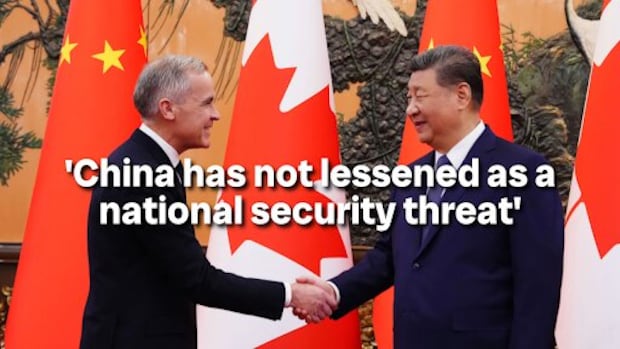
Prime Minister Mark Carney is gearing up to meet with Chinese President Xi Jinping as he works to reset the countries’ relationship. Former national security adviser Jody Thomas tells CBC News chief political correspondent Rosemary Barton that despite the re-engagement, China remains a security threat.
“Almost eight years of restricted high-level interactions imply that restoring mutual understanding between officials and institutions will be a gradual process. At this juncture, sustaining the momentum in stabilizing bilateral relations is itself a vital and attainable goal.”
The APEC summit is being held in Shenzhen, adjacent to Hong Kong. Canada has consistently voiced concerns regarding escalating repression in Hong Kong as the region transitions from semi-autonomy to total Chinese governance.
Earlier this month, Canada joined other Western nations in condemning the decade-long sentences for politicians and democracy advocates enforced under national security laws, notably Joshua Wong.
“We call for the immediate cessation of all unjust prosecutions of individuals charged,” states the joint declaration.
It encourages Chinese leaders to “fulfill their international obligations and uphold the rights and freedoms guaranteed to the people of Hong Kong” as established when the British government transferred sovereignty.
Carney has mentioned that he discusses human rights concerns privately with China but refrains from public condemnation.